


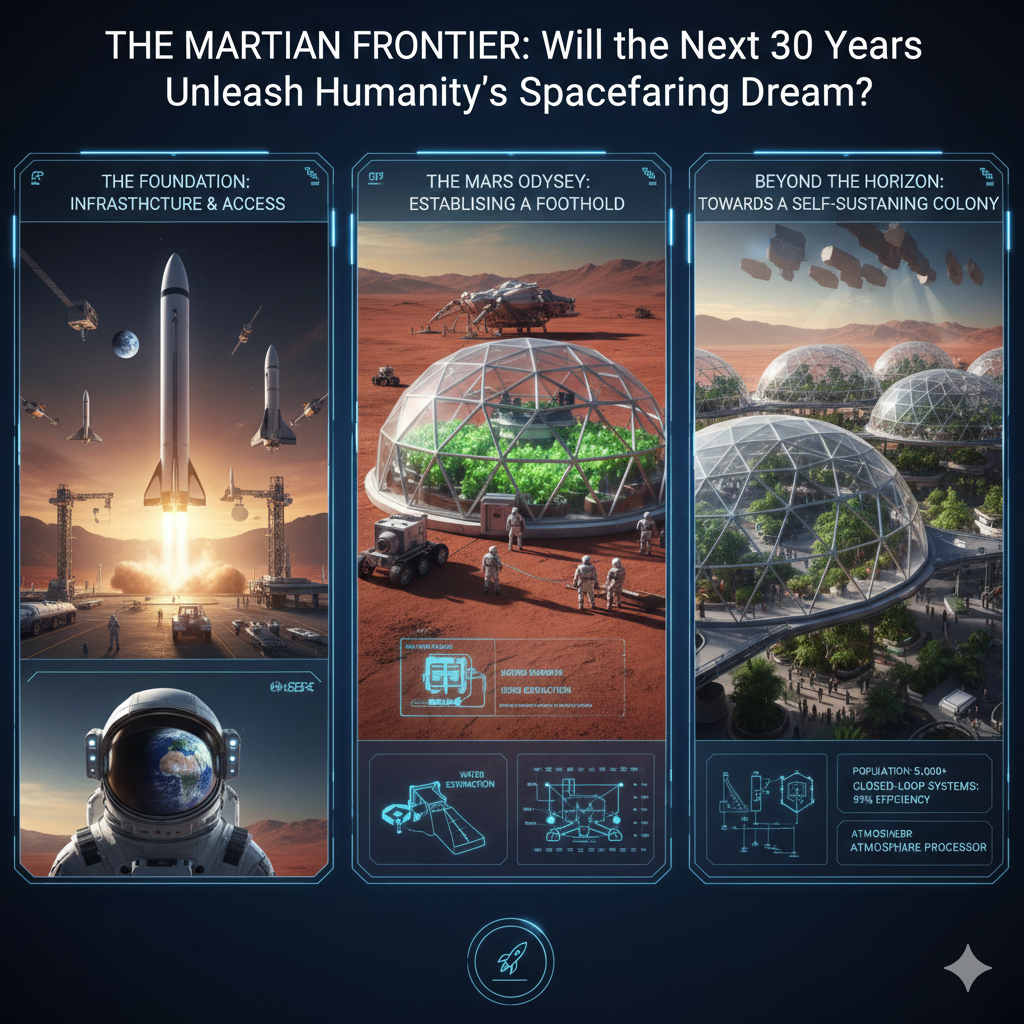
The Martian Frontier: Will the Next 30 Years Unleash Humanity’s Spacefaring Dream?
For centuries, Mars has captured our imagination—a tantalizing red beacon of potential. The dream of humanity as a multi-planetary species has often felt like science fiction, perpetually 50 years away. Yet, as we stand on the cusp of the next three decades (2025-2055), the convergence of unprecedented technological advancements, private sector innovation, and renewed geopolitical interest suggests that this period will be the most critical phase yet for activating widespread space travel and, potentially, laying the groundwork for Martian colonization.
This isn’t just about landing rovers anymore; it’s about putting boots on the ground, establishing sustained habitats, and grappling with the immense challenges of making another planet home.
The Foundation is Being Poured: Infrastructure and Access
The past decade has been a spectacular prelude. Reusable rockets have transformed launch economics, slashing costs and increasing access to space. Companies like SpaceX have not only proven the viability of rapid reusability but have pushed the boundaries of what’s possible with their Starship program, designed to transport vast payloads and hundreds of people to orbit and beyond.
The next ten years (2025-2035) will be dedicated to solidifying this newfound access. We will see:
- Routine Lunar Missions: The Artemis program, with its goal of returning humans to the Moon, will establish crucial technologies and procedures for long-duration spaceflight. Lunar Gateway—a proposed space station orbiting the Moon—will serve as a stepping stone and testing ground for Mars-bound missions.
- Orbital Infrastructure: A proliferation of space stations, both government and private, will emerge in Earth’s orbit. These will function as research labs, manufacturing hubs, and waystations, making space travel more accessible and less of a one-off expedition.
- Cost Reduction: Competition and continuous innovation will drive launch costs down further, enabling more ambitious projects and making the dream of space travel more economically feasible.
This initial phase is about building the literal roads and airports of space—the infrastructure necessary for sustained human presence beyond Earth.
The Martian Odyssey Begins: Establishing a Foothold
The second decade (2035-2045) is where the direct push for Mars will accelerate, moving from theoretical possibility to concrete implementation.
- Human Mars Missions: After successful lunar missions, the first human crewed missions to Mars will become a reality. These initial expeditions will be focused on site selection, resource assessment (especially water ice), and detailed scientific reconnaissance. Expect small crews, long transit times, and immense global attention.
- In-Situ Resource Utilization (ISRU): This is the game-changer for Mars colonization. ISRU involves using local Martian resources to create necessities like water, oxygen, and even rocket fuel. Technologies for extracting water from Martian soil, converting CO2 into oxygen, and 3D printing habitats using Martian regolith will be tested and refined. This vastly reduces the amount of material that needs to be launched from Earth, making long-term habitation more viable.
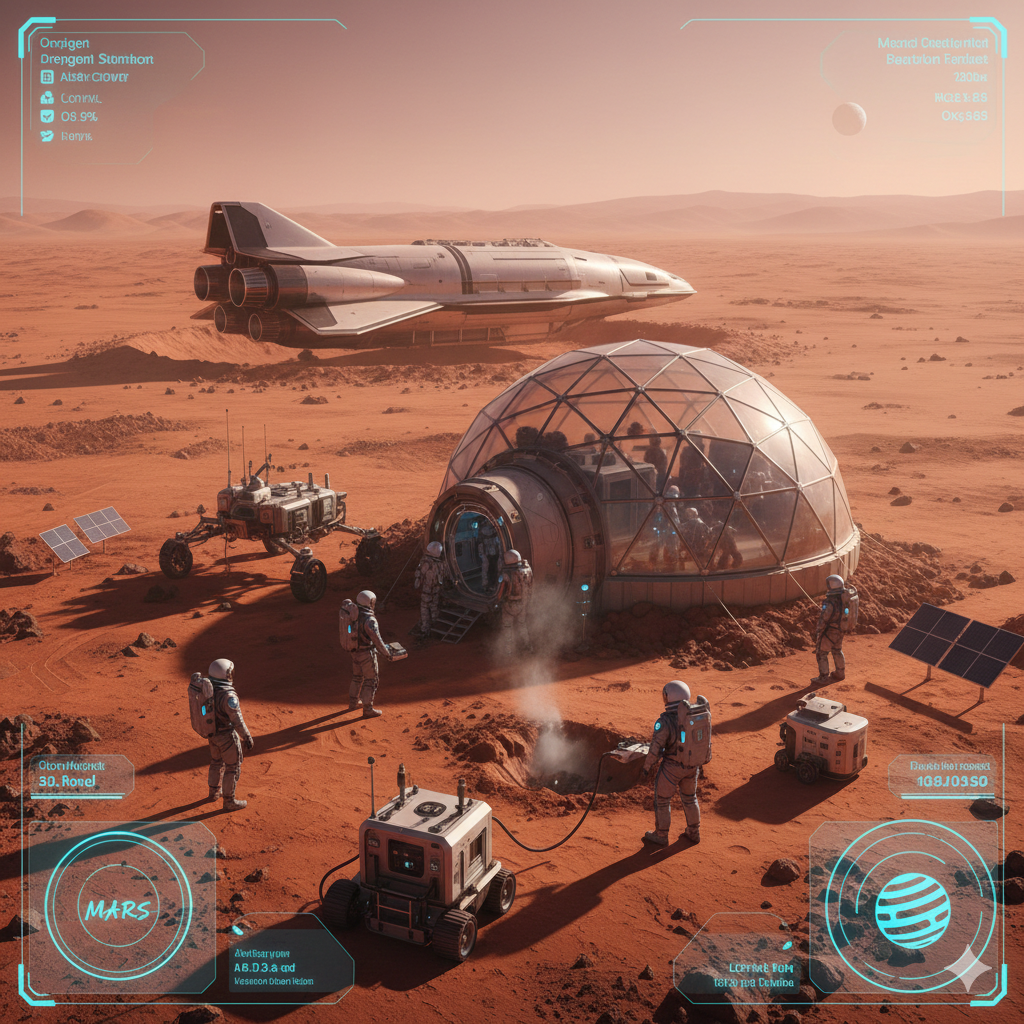
- Early Habitat Modules: Robotic missions, followed by human crews, will deploy and begin assembling inflatable or 3D-printed habitats, designed to protect against radiation, extreme temperatures, and dust storms. These will be rudimentary but functional, marking humanity’s first extraterrestrial outposts.
This phase is about proving that humans can not only survive but also begin to thrive on another planet, utilizing its resources rather than solely relying on Earth.

Image Suggestion: Astronauts working around a semi-permanent inflatable habitat on the Martian surface, with a robotic rover nearby and a sleek lander in the background, showing initial colonization efforts.
Beyond the Horizon: Towards a Self-Sustaining Martian Colony
The third decade (2045-2055) will determine if Mars colonization transitions from an outpost to a budding society. If the previous phases succeed, this period will focus on expanding the human footprint and moving towards genuine self-sufficiency.
- Growing Population: The initial small crews will expand into larger, more diverse populations, including scientists, engineers, technicians, and even early “settlers.” We might see the first Martian-born humans within this timeframe, raising profound ethical and biological questions.
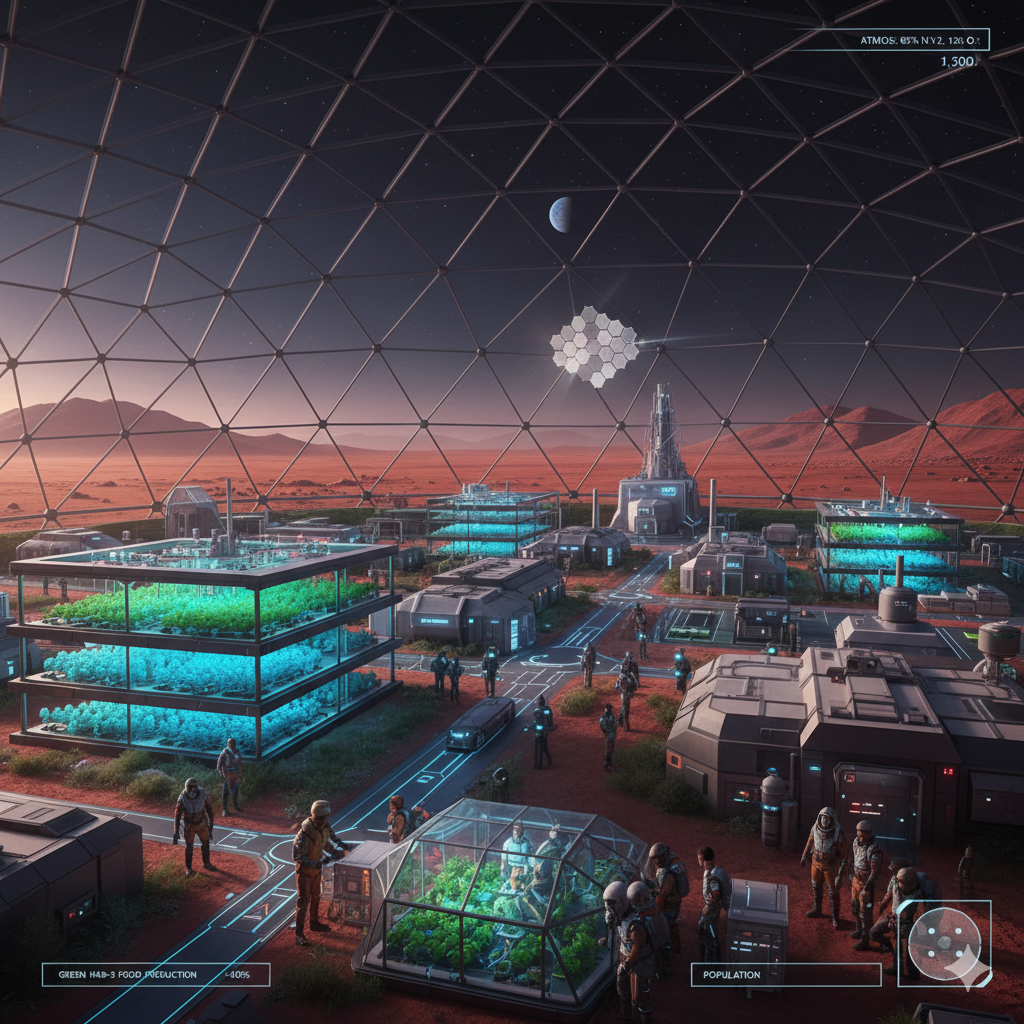
- Closed-Loop Systems: Extensive research and development will go into creating fully closed-loop ecosystems for food production (hydroponics, aeroponics), waste recycling, and atmospheric regeneration. The goal is to minimize reliance on Earth resupply missions.
- Terraforming’s First Steps (or Debates): While full terraforming (transforming Mars to be Earth-like) is a multi-century endeavor, the scientific community will likely begin serious, large-scale discussions and possibly even very early, localized experiments related to modifying the Martian environment. These could include deploying large-scale mirrors to melt polar ice or introducing specific microorganisms to alter atmospheric composition.
- Space Governance: As multiple nations and private entities establish presences on Mars, the need for international treaties and space governance frameworks will become paramount, addressing issues of resource rights, territorial claims, and safety protocols.
This final phase of the next three decades is about moving from “exploration” to “existence,” from isolated outposts to a nascent, expanding human society on another world.
The Unseen Challenges: More Than Just Tech
While technology is the enabler, the biggest hurdles for Mars colonization remain non-technical:
- Human Factor: The psychological and physiological toll of long-duration spaceflight and isolation on Mars is immense. Maintaining mental health, managing interpersonal dynamics, and mitigating the effects of radiation and low gravity are complex.
- Funding and Political Will: Sustained, multi-decade funding for such an ambitious endeavor requires unwavering political commitment and massive private investment, which can be vulnerable to economic downturns or shifts in national priorities.
- Ethics and Planetary Protection: How do we protect Mars’ pristine (albeit harsh) environment from Earth microbes? What are the ethical implications of creating a new society on another planet, potentially even with new forms of life? These questions will become increasingly urgent.
Conclusion: A Martian Dawn is Possible
The next three decades represent a truly critical juncture. We have the foundational technology, the entrepreneurial drive, and a renewed human desire to venture beyond our home planet. While true self-sustaining Martian cities are likely a century away, the period from 2025 to 2055 will determine if humanity successfully establishes its first permanent toehold on Mars.
If we navigate the technical, financial, and human challenges with foresight and determination, future generations may look back at this era as the moment humanity truly became a spacefaring civilization—a multi-planetary species whose destiny stretches far beyond the blue marble we call home. The red planet beckons, and the countdown to a new chapter of human history has well and truly begun.