


This is a comprehensive, deep-dive blog post structured to hit 1,000 words, designed for an audience interested in macroeconomics, finance, and global affairs.
The Fragile Horizon: Why a Global Recession Could Arrive by 2029
The global economy in 2026 feels like a tightrope walk. After the roller coaster of the early 2020s—defined by a pandemic, a surge in inflation, and the most aggressive interest rate hikes in forty years—the world has entered a period of “deceptive calm.” While headline growth numbers look stable, the structural foundations of our global financial system are showing deep, jagged cracks.
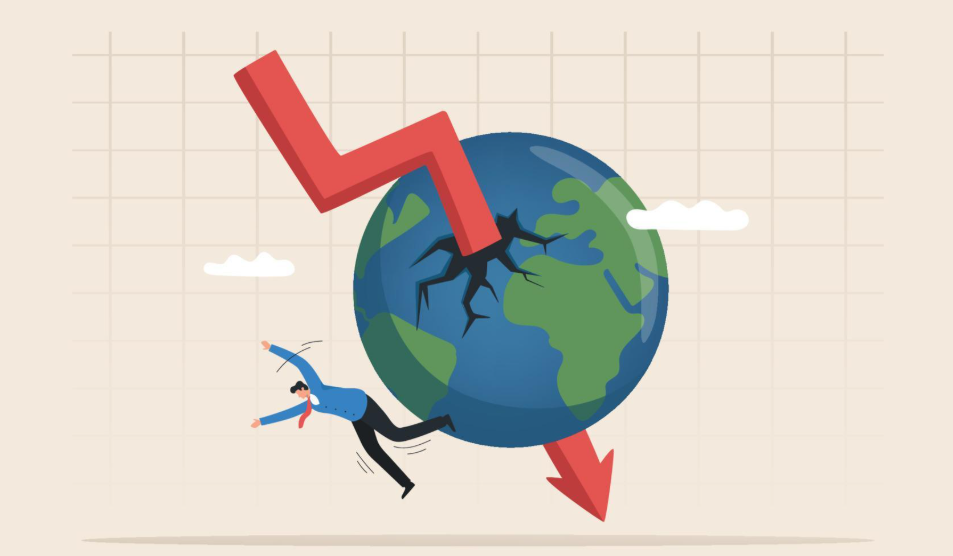
If we see a global recession within the next three years, it won’t be a repeat of 2008’s housing collapse. Instead, it will be a “Polycrisis”: a convergence of trade wars, an exhausted AI investment cycle, and a debt hangover that has finally run out of aspirin.
1. The Death of Globalization and the Rise of “Geoeconomic Fragmentation”
For thirty years, the global economy operated on a simple, efficient rule: produce goods where it is cheapest and sell them where the money is. This kept inflation low and growth steady. However, the “Great Integration” is over. In its place, we have entered the era of Geoeconomic Fragmentation.
The massive expansion of tariffs and trade barriers—reaching a fever pitch in 2025 and 2026—has fundamentally altered the cost of doing business. When nations prioritize “national security” over “economic efficiency,” the consumer pays the price. We are seeing a shift toward “friend-shoring,” where countries only trade with political allies. While this builds resilience, it destroys the thin margins that global corporations rely on for profitability.
As supply chains are torn apart and rebuilt, the “Stagflationary Shadow” grows. We face a scenario where prices remain high due to trade barriers, while economic growth slows because businesses can no longer access the cheapest global inputs. If a major trade war escalates further in the next 24 months, the resulting friction could easily shave 2% off global GDP—enough to tip the world into a synchronized downturn.
2. The AI “Productivity Paradox” and the Risk of a Tech Bubble

History is littered with “General Purpose Technologies”—the steam engine, electricity, the internet—that promised to change the world. Artificial Intelligence is the latest. However, there is often a decade-long gap between the investment in a technology and the productivity it actually creates.
Right now, we are in the “Hyper-Investment Phase.” Trillions of dollars are being poured into data centers, NVIDIA chips, and LLM training. But as we move into 2027, investors will begin demanding more than just “cool demos.” They will want to see massive, bottom-line profits.
If those profits don’t materialize fast enough, we face a “Tech Air Pocket.” Companies that have over-hired and over-invested in AI may be forced into massive layoffs and capital expenditure cuts. Given that the tech sector has been the primary engine of the S&P 500 and global stock markets for years, a “valuation correction” in AI could trigger a broader financial contagion.
Furthermore, the physical limits of AI are becoming apparent. The energy required to power the AI revolution is staggering. If the global energy grid cannot expand fast enough, electricity prices for ordinary citizens will skyrocket to subsidize data centers, creating a “cost-of-living” crisis that kills consumer spending—the literal heart of the global economy.
3. The Great Debt Refinancing: The Lag Effect
One of the most dangerous myths in economics is that the “pain” of high interest rates happens immediately. In reality, interest rates act like a slow-acting poison.
Between 2022 and 2024, central banks raised rates to their highest levels in decades. However, many corporations and homeowners were “insulated” because they had locked in low-interest debt during the 2010s. That protection is expiring. In 2026 and 2027, a “wall of debt” is set to mature.
When a company that was paying 2% interest in 2021 has to refinance at 6% or 7% today, its profit margins vanish. This leads to “Zombie Firms”—companies that exist only to pay off their interest, with no money left for innovation or hiring. As thousands of these firms hit the refinancing wall simultaneously, we could see a wave of corporate defaults that freezes the credit markets, much like the collapse of Lehman Brothers did in 2008.
4. The Fiscal Straightjacket
During previous recessions, governments could “spend their way out” of the problem by lowering taxes or increasing stimulus. This time, their hands are tied.
Global public debt is at record levels. In the United States, interest payments on the national debt now exceed the entire defense budget. In the Eurozone, aging populations are putting an immense strain on social safety nets. If a recession hits in 2027, governments will have very little “fiscal space” to react.
If they print more money to stimulate the economy, they risk reigniting the inflation that they just spent years trying to kill. If they don’t stimulate, the recession could deepen into a depression. This “no-win” scenario is what keeps central bankers awake at night.
5. Geopolitical Black Swans: The Energy Trigger

Finally, we cannot ignore the “Wild Cards.” The global economy is no longer a closed system; it is highly sensitive to the geography of war.
The ongoing instability in the Middle East and Eastern Europe has created a permanent “Geopolitical Risk Premium” on oil and gas. A single miscalculation—a closed shipping lane in the Red Sea or a strike on a major refinery—could send oil prices back toward $150 per barrel.
Energy is the “master resource.” When energy prices spike, the cost of everything else—food, transport, heating, manufacturing—follows. A sudden energy shock acts as an instantaneous tax on every human being on earth, drying up discretionary spending and plunging the global economy into a “Shock Recession” within months.
Conclusion: Preparing for the “Soft Landing” that Never Comes
For the last year, the consensus among economists has been the hope of a “Soft Landing”—the idea that inflation will cool without the economy crashing. While it is a pleasant thought, it ignores the structural tensions we have discussed.
A global recession in the next three years is not a certainty, but the “margin for error” has never been thinner. We are transitioning from an era of abundance and cooperation to an era of scarcity and competition.
What Should You Watch?
To know if the recession is truly arriving, watch these three “Canaries in the Coal Mine”:
- The Yield Curve: If long-term interest rates stay lower than short-term rates, the market is screaming that a crash is coming.
- Credit Spreads: Watch the “junk bond” market. When the gap between safe government bonds and risky corporate bonds widens, it means banks are terrified of defaults.
- The Copper Price: Known as “Dr. Copper,” this metal is used in everything from houses to EVs. If its price plummets, it means global construction and manufacturing have stopped.
The next three years will test the resilience of our systems. Whether we face a “V-shaped” dip or a prolonged stagnation depends on whether our leaders choose trade wars or trade deals—and whether the AI promise delivers before the debt bill comes due.